Are Crypto Casinos Legal in Canada? 2026 Rules Explained
Last updated: August 22, 2026
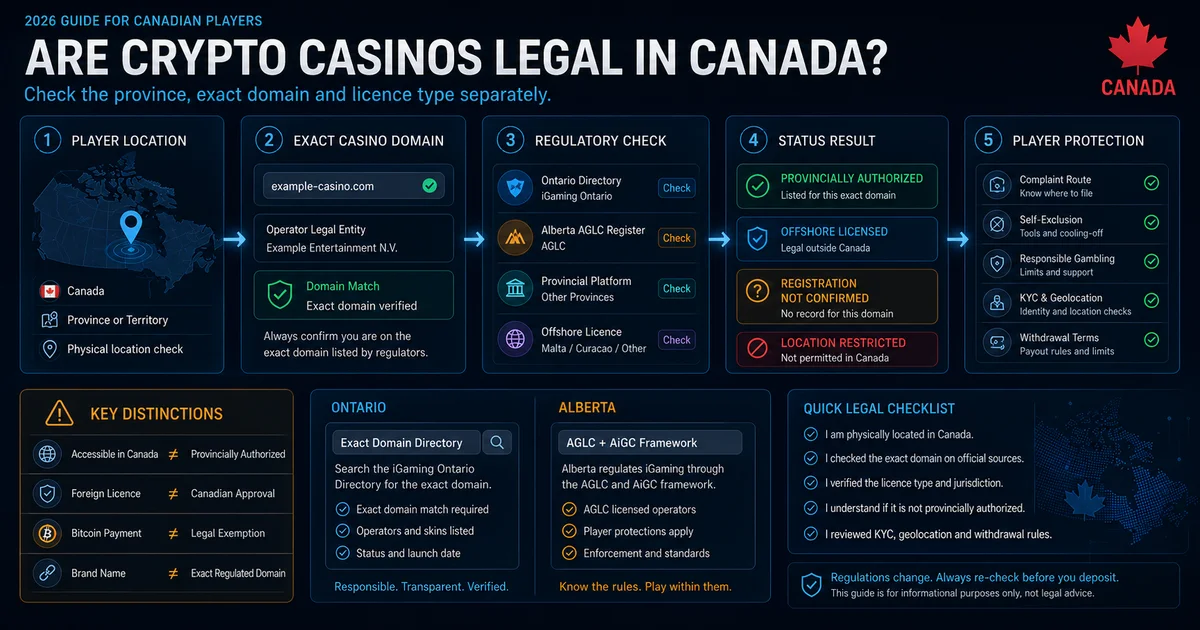
Canada does not have one nationwide licence for crypto casinos. Online gambling operates through a federal/provincial framework, and the regulatory status of a casino depends on the province, operator and exact domain. Ontario and Alberta now have competitive regulated iGaming markets, but their registered operators do not accept cryptocurrency; crypto casinos available to Canadians therefore generally sit outside those provincial regulated systems and may instead operate under foreign licences.
Access is not the same thing as provincial authorization. A Curaçao, Anjouan or other foreign licence can be a real operator credential, but it does not make that casino regulated by Ontario, Alberta or another Canadian province.
Local regulated-market rules apply
Offshore regulator, not Canadian authorization
No licence/domain evidence we can confirm
Check Ontario & Alberta Check a Casino Domain
This page provides general regulatory information, not individual legal advice.
Three Different Statuses: Provincially Regulated, Offshore or Unverified
| Status | What It Means | Crypto Deposits | Main Protection |
|---|---|---|---|
| Provincially regulated | The exact operator/site is inside a Canadian provincial regulated framework. Ontario uses AGCO registration plus the iGaming Ontario structure; Alberta uses AGLC registration plus an AiGC operating agreement. | Not accepted in the current Ontario or Alberta regulated markets. | Provincial oversight, account/fund rules, safer-gambling standards and a local regulatory framework. |
| Offshore foreign-licensed | The operator/domain may hold a genuine foreign gaming licence but is not thereby provincially authorized in Canada. | Commonly accepted, depending on operator and jurisdiction. | Protection and complaint routes depend on the foreign regulator and operator. |
| Unverified | We cannot verify a meaningful current licence, operator or domain certificate. | May still be offered, but the payment method proves nothing about regulatory status. | Weakest regulatory recourse. |
This distinction matters more than whether a homepage displays CAD, Interac, Bitcoin or a Canadian flag. A payment option is a cashier feature. It does not establish who regulates the operator.
The practical difference appears when something goes wrong. Inside a provincial regulated market, the operator must follow the local account, funds, safer-gambling and compliance framework that applies to that market. With an offshore site, the player’s regulatory route depends on the foreign operator and regulator instead. That does not automatically make every offshore casino unsafe, but it changes who can require the operator to correct a problem and which rules apply to the account.
Crypto is especially useful as a status signal in 2026 because the two Canadian competitive regulated markets now have explicit no-crypto rules. If an Ontario- or Alberta-facing casino account accepts a direct BTC, ETH or USDT deposit, that is a strong reason to verify whether you are actually on the provincially regulated domain rather than an international version of the brand.
Ontario: Regulated iGaming, but No Crypto Deposits
Ontario has a competitive regulated private-operator iGaming market. The practical check is the exact website: regulated operators are registered through the Alcohol and Gaming Commission of Ontario and operate within the iGaming Ontario framework. A familiar international brand name by itself is not enough to establish that the domain you opened is the Ontario-regulated version.
The crypto rule is unusually clear. Ontario’s current internet-gaming funds-management standard states that deposits must be appropriately verified and authorized and that cryptocurrency is not legal tender and shall not be accepted. You can verify that rule in the AGCO funds-management standard.
What this means: a gambling brand can operate a regulated Ontario product and also run or belong to a group with international sites elsewhere. The regulated Ontario account cannot simply use an offshore BTC or USDT cashier. Always check the exact Ontario domain rather than transferring the brand’s regulatory status from one website to another.
For Ontario, the safest status check is simple: verify the exact site in the current iGaming Ontario regulated-sites directory, then use the payment methods offered by that regulated account. If the site instead asks you to fund directly with Bitcoin, USDT or another cryptocurrency, do not describe it as an Ontario-regulated crypto casino.
This exact-domain rule also prevents a common review error. A company’s international homepage, Ontario homepage and affiliate landing page can look nearly identical while operating under different terms and payment rules. Before relying on an AGCO/iGaming Ontario claim, compare the address in your browser with the regulated-site listing. Do not transfer the licence status from a brand’s Ontario product to a different international domain merely because the branding matches.
Alberta: The Regulated Market Launched July 13, 2026
Alberta’s competitive regulated iGaming market officially launched on July 13, 2026. AGLC is the provincial regulator, while the Alberta iGaming Corporation (AiGC) oversees the commercial market. Operators must be registered with AGLC and have the required agreement with AiGC before operating their registered iGaming platform in the province.
Alberta also draws a clear line around crypto. The current AGLC Standards and Requirements for Internet Gaming state that cryptocurrency is not legal tender and must not be accepted. The standards also require player balances to be displayed in Canadian dollars.
So Alberta now resembles Ontario on the point that matters to this page: it has a competitive regulated private iGaming market, but it is not a regulated crypto-casino market. An offshore casino accepting BTC from an Albertan should not be described as AGLC-regulated merely because the site is accessible from Alberta.
Because Alberta’s competitive system is new, older casino articles that still describe the province as having only the previous provincial online-gambling route are now stale. For a 2026 check, use the current AGLC/AiGC framework and then distinguish that regulated market from offshore crypto sites. This is why the launch date and the no-crypto payment rule both belong high on this page rather than being buried in a province footnote.
How Canada’s Federal and Provincial Gambling Framework Works
The federal Criminal Code supplies the core statutory framework. Section 207 sets out permitted lottery schemes and includes the role of provincial governments in conducting and managing them under provincial law. The current text also contains provisions concerning authorized participation. The full statute is available from Justice Laws — Criminal Code section 207.
For practical online-casino research, the key point is that Canada does not issue a universal “Canadian crypto casino licence.” Provincial authorization is tied to the applicable provincial structure. A Curaçao licence, an Anjouan licence, CAD pricing, an Interac logo or a Canadian marketing page does not become federal or provincial Canadian authorization.
This is also why we avoid the common affiliate shortcut that says every offshore casino is simply “legal for Canadian players.” The statutory framework is more complicated than that slogan. The status we can verify objectively is whether the exact site sits inside a provincial regulated market, has a genuine foreign licence outside that market, or lacks meaningful licence evidence.
That approach is also more useful for rankings. A player does not need a long statutory commentary before every deposit; the player needs to know which regulator can be verified for the exact site, whether the province offers a regulated route, and whether the advertised payment method is compatible with that regulated framework. Those are facts that can be checked and kept current.
What About the Rest of Canada?
Outside Ontario and Alberta, provincial online-gambling structures differ. Several provinces rely primarily on provincially conducted or managed lottery and gaming products rather than the Ontario/Alberta model of a broad competitive private-operator iGaming market. The exact provincial route matters more than a generic “Canada” label.
For a crypto casino, the same test still works: ask whether the exact domain is part of your province’s regulated system. If it is not, a foreign licence may still tell you who operates the site and which foreign regulator supervises it, but that is a different status from provincial authorization.
Age, account eligibility, game availability and promotions can also differ by province and operator. A VPN does not change your physical location, provincial eligibility or the regulatory status of the domain you are using.
Foreign Casino Licence vs Canadian Provincial Authorization
These two ideas are often confused. A foreign licence can be genuine and useful without being Canadian.
What a foreign licence can prove
A strong regulator record can identify the legal operator, company number, licence number, licensed domain and current licence status. That is valuable evidence when we score an offshore crypto casino, especially when the regulator’s own certificate matches the exact website rather than merely the brand name.
What it does not prove
A foreign licence does not by itself establish AGCO/iGaming Ontario status, AGLC/AiGC status, Canadian provincial player-fund protection or access to a Canadian provincial complaint route. It also does not guarantee that every Canadian province, promotion or payment route is eligible.
This distinction is built into our casino ranking methodology: operator, licence and exact domain are checked separately from Canada access and payment support.
How to Check the Exact Casino Before You Deposit
- Identify the exact domain. Do not rely on the brand name or logo alone. A group can use different domains for different regulated markets.
- Check the provincial regulated directory where one applies. In Ontario, compare the exact site against iGaming Ontario’s current regulated list. In Alberta, check that the operator/site is part of the AGLC/AiGC regulated framework.
- If the casino is offshore, verify the foreign licence. Prefer the regulator’s own register or certificate showing operator, licence, domain and current status.
- Check current Canada/province eligibility. A valid foreign licence does not override an operator’s restricted-country or province rules.
- Separate payments from regulation. BTC, ETH or USDT support tells you how the cashier works. It does not tell you that a Canadian regulator authorized the site.
Fast rule: if the licence cannot be tied to the operator and exact domain, treat the regulatory claim as unverified until you can confirm it.
Gambling regulation and tax treatment are separate questions. Crypto transactions can create separate tax issues, so this legal-status page does not try to turn regulation into a tax guide.
What This Means Before You Choose a Crypto Casino in Canada
A foreign-licensed crypto casino is not being presented here as provincially regulated or “licensed in Canada” simply because Canadians can access it. If you deliberately consider an offshore crypto casino, verify the foreign operator/licence, exact domain and current Canada/province eligibility first.
This page stops at legal and regulatory status. If your intent has changed from checking that status to comparing casino options, use our current crypto casino ranking for Canada.