Top Casinos
Casino Reviews All Casino Reviews BitStarz Review Fairspin Review Weiss Casino Review Wild.io Review BetFury Review CryptoCasino.com Review FoxSlots Review AkibaWin Review
Guides New Crypto Casinos USDT Casinos Bitcoin Casinos Litecoin Casinos Dogecoin Casinos Ethereum Casinos Provably Fair Casinos Minimum Deposits Deposit Not Credited Fast Payout Casinos No KYC Crypto Casinos Crypto Casino Bonuses Wagering Requirements Withdrawal Limits KYC Triggers Withdrawal Problems
About How We Rank Methodology Responsible Gambling Privacy Policy Terms of Service Contact
18+/19+ depending on your province or territory | Play Responsibly | Affiliate Links | Gambling Risk

Are Crypto Casinos Legal in Canada? 2026 Guide

Last updated: July 15, 2026

Separate technical access, offshore licensing and Canadian provincial authorization before you deposit with Bitcoin, Ethereum or USDT.

Player vs operator
Ontario directory
Alberta 2026 market
Offshore licence checks
VPN and tax limits

Crypto casinos are accessible to many Canadians, but accessibility is not the same as provincial authorization. Provincially authorized sites operate inside a Canadian regulatory framework. Most offshore crypto casinos rely on foreign licensing and are not locally regulated by the player’s province.

Ontario has an established regulated private-operator market. Alberta’s expanded iGaming market became active on July 13, 2026, with registered operators required to work through the AGLC and Alberta iGaming Corporation framework. Bitcoin, Ethereum or USDT change the payment method, not the legal status of the operator.

This page provides general regulatory information, not legal advice for an individual case. Check the exact website, province and current operator status before depositing.

Check What “Legal” Means Check a Casino’s Status
James Caldwell, Lead Editor at CryptoCasino Canada
Reviewed by James Caldwell
Crypto gambling analyst • Canada-focused casino reviews • licensing, payment and player-protection checks
About the Author

Quick Answer: What Does “Legal” Mean Here?

A casino may open in a Canadian browser, accept a registration and hold a foreign licence while remaining outside the player’s provincial framework. Each check answers a different question.

What you can confirm What it proves What it does not prove
The website opens in Canada Technical accessibility Provincial authorization
The operator accepts Canadian registrations Current operator eligibility policy Approval by a Canadian regulator
The casino has a Curaçao, Anjouan or other foreign licence Regulatory status in another jurisdiction Ontario or Alberta authorization
The exact domain appears in Ontario’s directory Participation in Ontario’s regulated market Authorization in every other province
The operator is registered for Alberta iGaming AGLC registration within Alberta’s framework Automatic availability across Canada
The cashier accepts Bitcoin or USDT Support for a crypto payment route Legal authorization to conduct gambling
The site offers responsible-gambling tools Operator controls and policies Provincial enforcement or complaint access
A VPN allows account access A changed connection location Player eligibility or the right to withdraw

Status in practice: “available to Canadians,” “offshore licensed” and “provincially authorized” describe different things.

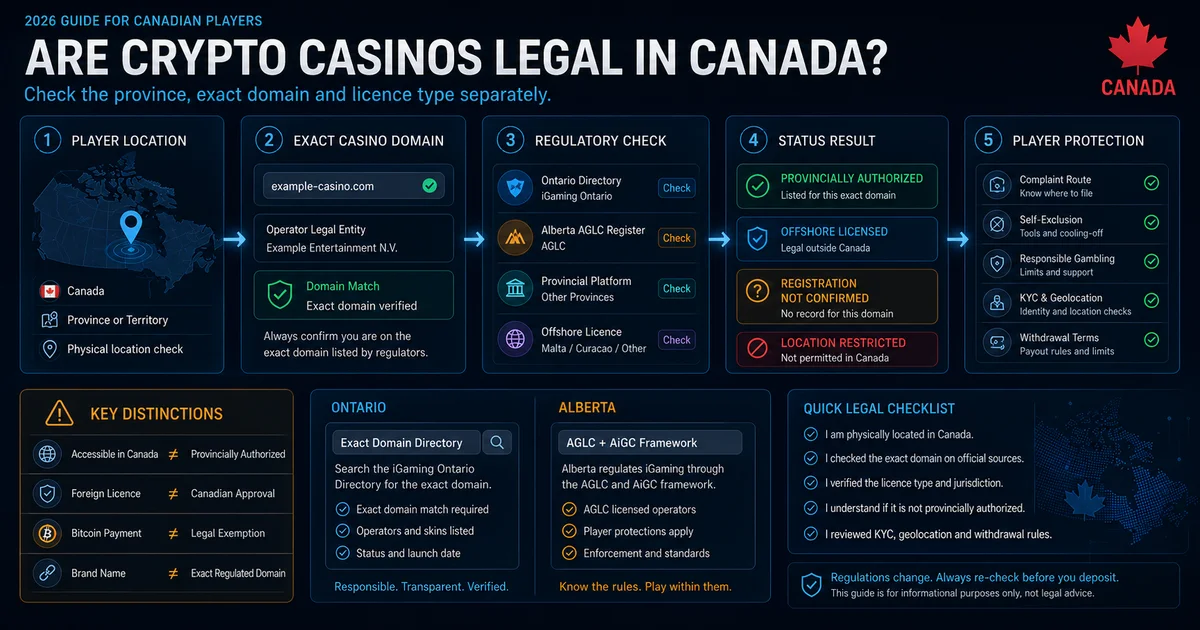
Canadian crypto casino legal status check by province, exact domain and licence type
Check the province, exact casino domain and regulatory framework separately. A foreign licence or Bitcoin cashier does not establish Canadian provincial authorization.

How Canadian Gambling Law Is Structured

Canada’s Criminal Code establishes the federal framework for gaming and betting. Section 207 identifies permitted lottery schemes, including schemes conducted and managed by provincial governments in accordance with provincial legislation. That structure gives provinces a central role in deciding how lawful gambling is organized within their territory.

The Code does not need to name Bitcoin casinos separately. A crypto casino still offers gaming and betting; cryptocurrency only changes how money is deposited, wagered or withdrawn. The operator, location and provincial framework remain the decisive regulatory questions.

Federal framework:
gaming and betting provisions
→ permitted schemes under section 207
→ provincial conduct and management
→ registered private operators where a province has created that model

The official wording is available in Criminal Code section 207. The provision is not a blanket nationwide approval for every private or offshore website. It explains the legal foundation on which provincial systems operate.

Section 207(3)(b) also contains a summary-conviction offence provision for participating in a lottery scheme in a way that is not authorized under section 207. The Code therefore does not provide players with a blanket exemption for offshore play. How that provision applies to a specific foreign-hosted casino and player situation can depend on the operator, location and facts, so technical access should not be described as automatic legality.

Offshore online gambling is often described as a grey market because technical access, foreign licensing and Canadian provincial authorization do not always align. For a practical answer, verify whether the exact site operates inside the framework that applies where the player is located.

Player Access and Operator Authorization Are Different Questions

Operator Side

  • Who conducts and manages the gambling operation?
  • Is the operator registered within a provincial framework?
  • Is there a commercial agreement with the provincial entity?
  • Which exact domains and products are covered?
  • Which advertising, reporting and responsible-gambling rules apply?

Player Side

  • Where is the player physically located?
  • Has the player reached the applicable provincial age?
  • Do the operator’s current terms accept that location?
  • Is a provincial complaint or self-exclusion route available?
  • Will geolocation, KYC and withdrawal rules be satisfied?

A casino can accept a Canadian registration without being provincially authorized. That is an operator-access decision, not proof of Canadian regulatory approval. The restricted-country list may show whether the operator currently permits registration, but it does not replace the province’s official directory or register.

Canadian regulation and enforcement focus heavily on who conducts and manages gambling, but the Code also addresses unauthorized participation. That prevents a blanket claim that offshore access is automatically lawful; application to a foreign-hosted site and a particular player depends on the operator, location and facts.

For practical risk assessment, compare the exact domain, local status, operator terms, complaint path, KYC triggers and withdrawal rules before paying. Our crypto casino review checklist covers the wider trust audit.

Ontario: How to Check a Regulated Casino

Ontario operates a regulated competitive iGaming market. The strongest evidence is not a brand name, app-store listing or logo in an advertisement. It is the exact website domain listed in the provincial market directory.

  1. Open the iGaming Ontario regulated-site directory.
  2. Search for the exact casino name and domain you intend to use.
  3. Confirm that the domain belongs to an operator contracted within the Ontario market.
  4. Use the Ontario-facing version rather than the brand’s global offshore site.
  5. Check the current age, physical-location and account rules before playing.

Ontario’s regulated market requires players to be at least 19 and physically located in Ontario when playing. A global brand and an Ontario-regulated version can use different domains, terms, payment options and complaint processes.

Brand-level statement Correct domain-level check
“This international brand operates in Ontario” Confirm the exact Ontario domain in the current directory
“The brand has an AGCO or iGO relationship” Do not assume every global domain is covered
“The offshore site accepts Ontario registrations” Acceptance does not establish regulated-market status

Alberta: The Expanded iGaming Market from July 13, 2026

Alberta’s position changed materially on July 13, 2026. The expanded market is now active under a two-part model: AGLC handles regulatory registration and oversight, while the Alberta iGaming Corporation handles commercial agreements, financial matters and related market functions.

AGLC states that operators must be registered and have a signed commercial agreement before conducting and managing a legally registered platform in Alberta. Its public gaming-registrant database now includes iGaming operators and suppliers.

Alberta status check:
exact operator or legal entity
→ AGLC iGaming registration
→ AiGC commercial agreement and approved operation
→ current site, advertising and player-location requirements

Use the official AGLC iGaming information and register access rather than relying on a casino’s general Canada page. Registration under a legal entity can differ from the public-facing brand, so check the entity, domain and current operating status together.

Alberta’s framework also includes centralized self-exclusion integration and a provincial compliance complaint process. AGLC can investigate whether a regulated operator broke provincial rules, but it states that it cannot directly order a casino to return money or resolve every individual payment dispute.

The market is new and its operator list can change quickly. Neither an international licence, Ontario registration nor an application announcement establishes Alberta authorization.

What About the Rest of Canada?

Online gambling rules and official platforms are organized provincially. Ontario and Alberta now have regulated private-operator models, while other provinces and territories primarily rely on their government-run lottery and gaming systems.

Outside those frameworks, an accessible offshore site remains separate from provincial authorization. The player generally cannot assume that the local provincial gaming authority supervises the operator or domain.

Market type Typical status check Main limitation
Government-run provincial platform Official provincial lottery or gaming corporation Products and payment methods are limited to that platform
Regulated private-operator market Ontario directory or Alberta registration framework Authorization applies within the relevant province and covered operation
Offshore-access market Foreign licence, operator terms and restricted-country policy No automatic local provincial oversight

Age limits, geolocation rules and authorized platforms differ. Ontario’s 19+ requirement should not be copied as a single national age rule. Check the official rules in the province or territory where you are physically located.

Offshore Licence vs Canadian Provincial Authorization

An offshore licence can still matter. It may identify the company, licence holder, foreign regulator, complaint procedure and compliance history. The mistake is presenting that licence as Canadian approval.

Check Offshore licence Provincial authorization
Regulator Foreign jurisdiction such as Curaçao or Anjouan Applicable Canadian provincial framework
Canadian status Does not authorize the site across Canada Applies to the covered province, operator and operation
Exact domain check Operator website and foreign licence record Ontario directory or Alberta registration information
Complaint path Operator and foreign regulator process Operator process plus provincial compliance route
Self-exclusion Operator-specific or foreign scheme Provincial integration may be required
Crypto payments May be supported Depends on the approved operator setup

Offshore does not automatically mean fraudulent. It means the player generally cannot rely on the same provincial oversight, directory, self-exclusion system and compliance process available inside a regulated Canadian market.

A foreign regulator may supervise the operator under its own rules, while Ontario, Alberta and other provincial requirements remain separate.

Does Using Bitcoin Change the Legal Status?

No. Bitcoin changes how the deposit is transferred, not who is authorized to operate the casino. The same distinction applies to Ethereum, Litecoin and stablecoins.

A casino can accept Bitcoin and be provincially authorized, offshore licensed or have an unclear regulatory status. The blockchain does not create a Canadian gambling-law exemption. It only adds payment issues such as wallet ownership, network selection, transaction finality and crypto record keeping.

Choose a payment route only after checking the operator. Our Bitcoin casino guide covers BTC cashier mechanics, while the USDT casino comparison explains why token network selection matters.

AML registration, KYC controls or transaction reporting are separate compliance layers. They do not by themselves prove that an online casino is provincially authorized.

What Protection Changes Outside a Provincial Market?

Provincial regulation does not guarantee that every account, verification or withdrawal dispute will be resolved in the player’s favour. It does establish a local framework that an offshore licence normally cannot provide on its own.

  • Public status checks: official directories or registrant information.
  • Local standards: provincial rules for operators, advertising and responsible gambling.
  • Self-exclusion: integration across regulated platforms where required.
  • Compliance complaints: a provincial authority can investigate rule breaches.
  • Account processes: regulated sites must publish relevant complaint and decision procedures.
  • Enforcement: provincial regulators can issue warnings, suspensions or monetary penalties for violations.

The impact becomes clearest when something goes wrong. An offshore operator may still have a formal complaint process, but a Canadian provincial regulator may have no jurisdiction over that operator or domain.

Before depositing, review the cashier, account restrictions and dispute procedure. Our guides on crypto casino KYC triggers and withdrawal problems cover common points where eligibility issues appear.

VPN and Tax Questions

Can Canadians Use a VPN to Access a Restricted Casino?

Do not use a VPN to bypass a provincial, casino or licence restriction. A VPN only changes the apparent connection location; physical location and eligibility remain unchanged.

A location mismatch may surface during geolocation, KYC or withdrawal review. Ontario’s regulated market requires physical presence in the province. Offshore terms can also restrict countries, provinces, VPN use or misleading account details. Access at registration does not guarantee payment approval later.

Are Crypto Casino Winnings Taxable in Canada?

Recreational gambling winnings are generally not treated as business income. Tax treatment can change when the activity amounts to the business of gambling, which depends on the organization, commerciality, skill, information and the player’s overall conduct.

Crypto adds a second event. Receiving a gambling win and later selling, trading or spending the crypto are not necessarily the same tax question. CRA guidance treats crypto gambling as an event requiring valuation and record keeping, while a later disposition can create business income or a capital gain or loss depending on the circumstances.

Keep the date, asset amount, Canadian-dollar value, wallet transaction and later disposition records. Review the current CRA crypto-asset tax guidance for substantial winnings or frequent activity.

How to Check a Crypto Casino’s Status

  1. Identify the province: use the rules for the location where you will actually play.
  2. Copy the exact domain: do not rely only on the brand name or search ad.
  3. Check the provincial source: use Ontario’s directory or Alberta’s official iGaming information where applicable.
  4. Identify the legal entity: compare the company name in the terms with the provincial or foreign record.
  5. Separate licence types: foreign licensing is not provincial authorization.
  6. Read location restrictions: confirm that Canada and the relevant province are permitted under current terms.
  7. Check age and geolocation: these are provincial and operator-specific.
  8. Find the complaint path: note whether the regulator can supervise the exact operator and domain.
  9. Review self-exclusion: compare operator-only tools with provincial integration.
  10. Read KYC and withdrawal rules: eligibility disputes often appear when funds are withdrawn.
  11. Avoid VPN workarounds: technical access does not cure a restriction.
  12. Save the evidence: keep the terms date, licence details, exact domain and cashier screenshots.

A logo or licence number should be checked against the relevant official source. A screenshot from an affiliate review is not a regulatory record.

Offshore Crypto Casinos With Published Licence Information

The operators below publish foreign licence information and did not name Canada in the general restricted-country lists reviewed on July 15, 2026. This does not establish provincial authorization or individual eligibility. Check the exact domain, current terms, province and game-provider restrictions before registering.

Affiliate disclosure: The casino buttons below are sponsored. These operators are reviewed as offshore casinos and are not presented as provincially authorized Canadian sites.

Curaçao-Licensed Operator
BitStarz casino logo

BitStarz

Foreign licence with published restricted-country terms

BitStarz is managed by Gareton B.V. and lists Curaçao Gaming Authority licence OGL/2024/165/0185. Canada was not named in the general restricted-country list reviewed on July 15, 2026, although Canada-specific game and provider restrictions still apply.

  • Regulatory category: offshore operator
  • Foreign licence: Curaçao Gaming Authority
  • Provincial status: not presented here as Ontario- or Alberta-authorized
  • Player check: confirm the exact domain and current location rules
Visit BitStarz Read BitStarz Review
Anjouan-Licensed Operator
Wild.io casino logo

Wild.io

Published foreign licence and jurisdiction restrictions

Wild.io is operated by Stack Gaming Ltd. under Anjouan licence ALSI-202504044-FI2. Canada was not named in the general restricted-country list reviewed on July 15, 2026.

  • Regulatory category: offshore operator
  • Foreign licence: Anjouan Gaming Authority
  • Provincial status: not presented here as Ontario- or Alberta-authorized
  • Player check: review the exact network, domain and location terms
Visit Wild.io Read Wild.io Review
Curaçao-Licensed Operator
BetFury casino logo

BetFury

Published licence and restricted-country guidance

BetFury identifies Universe B Games B.V. and Curaçao Gaming Authority licence OGL/2024/1494/0942. Canada was not named in the published restricted-country guidance reviewed on July 15, 2026. The list is not presented as exhaustive, so current eligibility must still be checked.

  • Regulatory category: offshore operator
  • Foreign licence: Curaçao Gaming Authority
  • Provincial status: not presented here as Ontario- or Alberta-authorized
  • Player check: verify current terms before registration and deposit
Visit BetFury Read BetFury Review

Crypto Casino Laws in Canada FAQ

Are crypto casinos legal in Canada?
Provincially authorized online casinos operate legally inside their applicable Canadian framework. Offshore crypto casinos may be accessible to Canadian players without being authorized by the player’s province. Check the exact domain, province and operator status rather than treating Bitcoin support as proof of legality.
Is it illegal for a Canadian to use an offshore crypto casino?
Canadian law does not give players a blanket exemption for offshore play. Section 207(3)(b) includes a summary-offence provision for participation in a lottery scheme that is not authorized under section 207. Whether that provision applies to a specific foreign-hosted casino and individual player situation can depend on the operator, location and facts. Check the applicable provincial framework and obtain legal advice for an individual case.
Does a Curaçao or Anjouan licence make a casino legal in Canada?
No. A foreign licence establishes regulatory status in that foreign jurisdiction. It does not replace Ontario registration, Alberta registration or another Canadian provincial authorization. The licence can still help identify the operator and foreign complaint process.
How do I check whether a crypto casino is regulated in Ontario?
Search the exact website domain in the iGaming Ontario regulated-site directory. Do not rely only on an international brand name, advertisement or logo. The Ontario-facing domain, operator and current directory entry must match.
What changed in Alberta on July 13, 2026?
Alberta’s expanded iGaming market became active under an AGLC and Alberta iGaming Corporation framework. Operators must be registered with AGLC and have the required commercial agreement before conducting and managing a registered platform in the province.
Are online casino laws the same in every Canadian province?
No. Provinces use different authorized platforms, age rules, geolocation requirements and regulatory models. Ontario and Alberta have regulated private-operator frameworks, while other jurisdictions primarily use provincial government gaming systems.
Does paying with Bitcoin change whether a casino is legal?
No. Bitcoin changes the payment route, not the operator’s authorization. A Bitcoin casino can be provincially authorized, offshore licensed or outside a confirmed regulatory framework. Check the operator and exact domain separately from the cryptocurrency.
Can I use a VPN to access a blocked crypto casino?
A VPN does not create player eligibility or change physical location. Using one to bypass a provincial or casino restriction can cause geolocation, KYC or withdrawal problems and may breach the operator’s terms.
Are crypto casino winnings taxable in Canada?
Recreational gambling winnings are generally not treated as business income, but organized gambling activity can be taxable as a business in exceptional cases. Crypto also creates a separate record-keeping issue because a later sale, trade or use can produce a capital gain, capital loss or business result.
What protection does provincial regulation add?
A provincial framework adds official status checks, local operator standards, responsible-gambling requirements, self-exclusion integration and a compliance complaint route. It does not guarantee that every individual account or payment dispute will be decided in the player’s favour.

Final Answer: Are Crypto Casinos Legal in Canada?

Provincially authorized online casinos operate legally inside the Canadian framework that covers them. Offshore crypto casinos may accept Canadian players, but a foreign licence and technical access do not create provincial authorization.

Check the exact domain, player location and current provincial source before depositing. Ontario users should use the iGaming Ontario directory. Alberta users should verify the operator through the active AGLC/AiGC framework. Players elsewhere in Canada should distinguish their province’s official gaming system from an offshore site that merely accepts registrations.

Crypto does not create a legal loophole. It adds payment, wallet and tax considerations to the same underlying question: who is authorized to conduct and manage the gambling operation where the player is located?

Run the Status Checklist Compare Crypto Casino Reviews