What Triggers KYC at Crypto Casinos?
A crypto casino usually asks for KYC because it needs to confirm who controls the account, where a payment came from, where a payout is going, or whether an account or transaction needs a deeper compliance review.
There is no single withdrawal amount that automatically triggers KYC at every offshore crypto casino. Some operators reserve verification for withdrawal processing or flagged activity, while others can ask for documents at any stage.
Last updated: August 21, 2026
Identity check: the casino is trying to match the account to a real person.
Payment ownership check: the casino wants evidence that the deposit or payout route belongs to you.
Source-of-funds review: the question has moved beyond basic identity.
Withdrawal-stage verification: first find out whether the payout is still inside the casino process.
Why Casinos Ask for ID Before a Withdrawal
A crypto deposit can reach a casino before a full identity review. At withdrawal, the operator may check the account holder, payment route, destination and compliance signals before releasing funds.
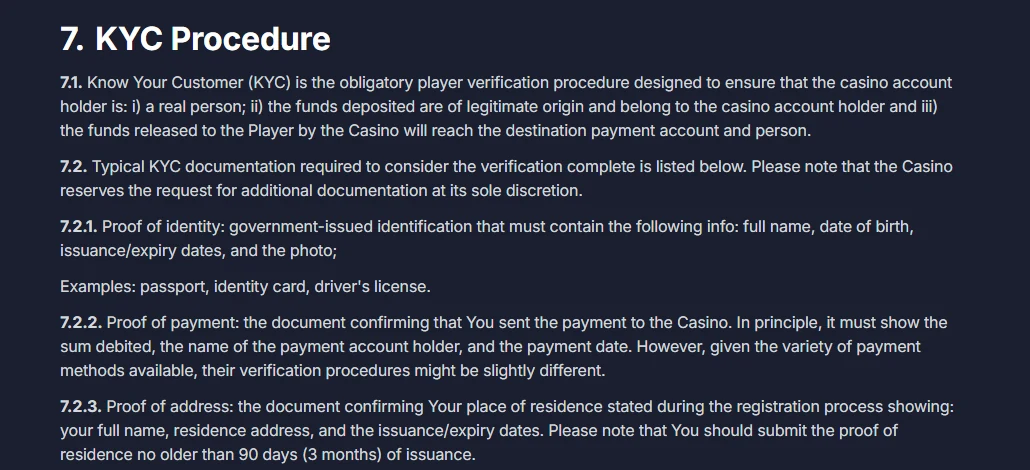
BitStarz, for example, currently reserves the right to perform additional verification during withdrawal processing for both fiat and cryptocurrency players. Its terms also connect KYC with confirming the player, the origin and ownership of deposited funds, and the destination of released funds. That is a useful real-world example of withdrawal-stage verification, but it is not a universal rule for every casino.
First Withdrawal vs Later Verification
A first withdrawal can be the first time a player encounters document checks because some casinos allow signup and deposits before KYC. That does not mean every first cashout triggers verification, or that later checks cannot happen if account, payment or risk conditions change.
Large or Unusual Activity Without a Universal Threshold
Do not assume that C$500, C$1,000 or any other number is a universal offshore KYC threshold. Some operator policies are discretionary or risk-based. BetFury’s current terms, for example, allow KYC at the deposit or withdrawal stage when its AML/risk process requires it, and its review can include source of funds, source of income, jurisdiction and gambling-activity patterns. The useful signal is the type of review being opened, not a made-up risk score.
KYC Trigger Map: What Changed on the Account?
When verification appears unexpectedly, start with what changed immediately before the request.
| Trigger Family | Example Signal | Likely Type of Check | What to Verify Next |
|---|---|---|---|
| Identity / profile inconsistency | Name, age, address or account detail does not match submitted evidence | Identity or address verification | Which exact field or document is mismatched? |
| Withdrawal / account ownership review | Verification request appears while a payout is being processed | Identity, account-control or payout review | Is the withdrawal still pending inside the casino, and what evidence is required? |
| Wallet / payment-route change | New payout wallet, different payment route or ownership question | Payment or wallet ownership review | Can you prove the relevant deposit or payout route belongs to you? |
| Device / location inconsistency | Location or account-access data conflicts with the account or jurisdiction rules | Location, security or jurisdiction review | Are your account details and actual access location consistent with the operator’s rules? |
| Bonus / multiple-account / fraud review overlap | Duplicate-account concern, unusual account behaviour or bonus-rule investigation | Anti-fraud review that may sit beside KYC | Is the casino asking for identity, or is the real issue a bonus/account-rule dispute? |
| Source-of-funds / enhanced review | Request for bank, exchange, employment or crypto-origin records | Source-of-funds or enhanced compliance review | Which funds or transaction period does the operator want documented? |
What Kind of Verification Is the Casino Asking For?
Identity and Address Verification
This is the basic KYC layer. Current operator policies commonly use government-issued photo ID and may also request proof of residence. BitStarz lists a passport, identity card or driver’s licence as identity examples and separately asks for proof of address when required. BetFury’s terms also allow a picture ID and can include a selfie in its KYC process.
Check that the evidence matches the name, date of birth and address attached to the account, and send the exact replacement document the operator requests.
Payment or Wallet Ownership Verification
This review is about control of the money route, not only your face or address. BitStarz’s current KYC terms include proof of payment, and its withdrawal rules generally require withdrawal through the same method used to deposit. BetFury also reserves the right in AML cases to require a withdrawal back to the same wallet used for the deposit.
For crypto, evidence may include a transaction record, exchange-account record or other payment confirmation. A blockchain address alone does not necessarily prove account ownership.
Source of Funds and Enhanced Review
A source-of-funds request is deeper than basic KYC. The operator is asking where the money used on the account came from. Wild.io’s current help material, for example, lists salary records, investment or property-sale records, inheritance evidence and crypto-mining records among possible source-of-funds documents. BetFury’s terms similarly allow requests about occupation, source of funds and source of income.
Source-of-funds reviews are operator-specific; there is no single document package every crypto casino must accept.
Documents a Crypto Casino May Ask For
Document rules vary by operator. The table below shows the purpose of each request, not a guaranteed list for every casino.
| Request Type | Typical Evidence | What Must Match |
|---|---|---|
| Identity | Passport, national ID card or driver’s licence | The person, name and date-of-birth details used on the casino account |
| Address | Recent utility bill, bank statement or other accepted address document | The registered residential address and the operator’s document-age rule |
| Selfie / liveness | Selfie with ID, live video or another operator-specified identity check | The person presenting the document matches the account holder |
| Payment / wallet ownership | Payment confirmation, wallet or exchange record, transaction details | The relevant deposit or payout route can be connected to the account holder |
| Source of funds | Bank, income, investment, sale or crypto-origin records requested by compliance | The owner and origin of the funds under review |
KYC Appeared After You Requested a Withdrawal: What to Do
- Record the exact request and withdrawal status. Save the cashier status, date, amount, coin/network and the wording of the KYC message.
- Ask what exact evidence is missing. “Complete KYC” is too vague if support has not said whether it needs ID, address, payment ownership or source of funds.
- Use the operator’s official verification or support channel. Do not send sensitive documents to an address or chat account you cannot verify as belonging to the casino.
- Check consistency. Name, address and payment ownership should line up with the account information and the route used to deposit or withdraw.
- Do not create a second account or keep changing payout routes. That can add another account-security or ownership question while the original review is open.
- Preserve the evidence. Keep support replies, document-request emails, transaction records and screenshots of the withdrawal status.
- Separate KYC from the payout problem. Once verification is complete, ask whether the withdrawal has actually been sent and whether a TXID exists.
Not Every Payout Block Is KYC
Bonus or Wagering Review
If support is talking about remaining wagering, a maximum-bet breach, excluded games, bonus balance or promotion conditions, the core problem is not identity verification. A casino can investigate bonus use at the same time as KYC, but the two questions should be separated.
For the calculation and rule branch, use our crypto casino wagering requirements guide.
Withdrawal Limits or Split Payouts
A minimum withdrawal, daily/weekly cap or staged payout can delay the full amount without any ID request. If the casino is quoting a cashout limit rather than asking who you are, move to the crypto casino withdrawal limits guide.
Wrong Network, Missing Deposit or Wallet-Route Problem
A wrong chain, missing memo/tag or deposit that never credited is a transaction-routing problem. It may eventually require ownership evidence, but the first job is to identify the transaction and destination. Use the crypto casino deposit not credited guide for that branch.
Canada Context: KYC Rules Do Not Create One Offshore Casino Threshold
FINTRAC requires casinos covered by Canada’s anti-money-laundering framework to verify identity for specific activities. Its current casino guidance includes large virtual-currency receipts of C$10,000 or more, casino disbursements of C$10,000 or more, and suspicious transactions regardless of amount. It also has identity rules around casino accounts and other specified transactions.
Those rules do not mean every offshore crypto casino accessible to a Canadian player must trigger KYC at C$10,000. FINTRAC defines which Canadian casino entities are reporting entities under the PCMLTFA; offshore operators can be governed by different licences, terms and risk systems. Use the Canadian rules as context for why AML/KYC exists, not as a universal offshore withdrawal threshold. For the broader market distinction, see our Canada crypto casino legality guide.
Before You Submit Documents: Final KYC Checklist
- Confirm you are dealing with the correct casino domain and official support or verification channel.
- Read the request again and identify the exact document or evidence category being asked for.
- Check that account name and identity details are consistent.
- If proof of address is requested, use a document that meets that operator’s recency and format rules.
- If payment or wallet ownership is requested, preserve the relevant transaction and account records.
- Provide source-of-funds evidence only when the operator specifically requests it and follow its stated document rules.
- Keep a copy of the KYC request, your submission confirmation and the withdrawal status.
- If KYC is complete but the payout is still pending, rejected or has no TXID, switch to the withdrawal-problems diagnosis rather than resending identity documents blindly.
Choosing a casino before signup and want lower verification friction? Compare lower-verification crypto casinos instead.